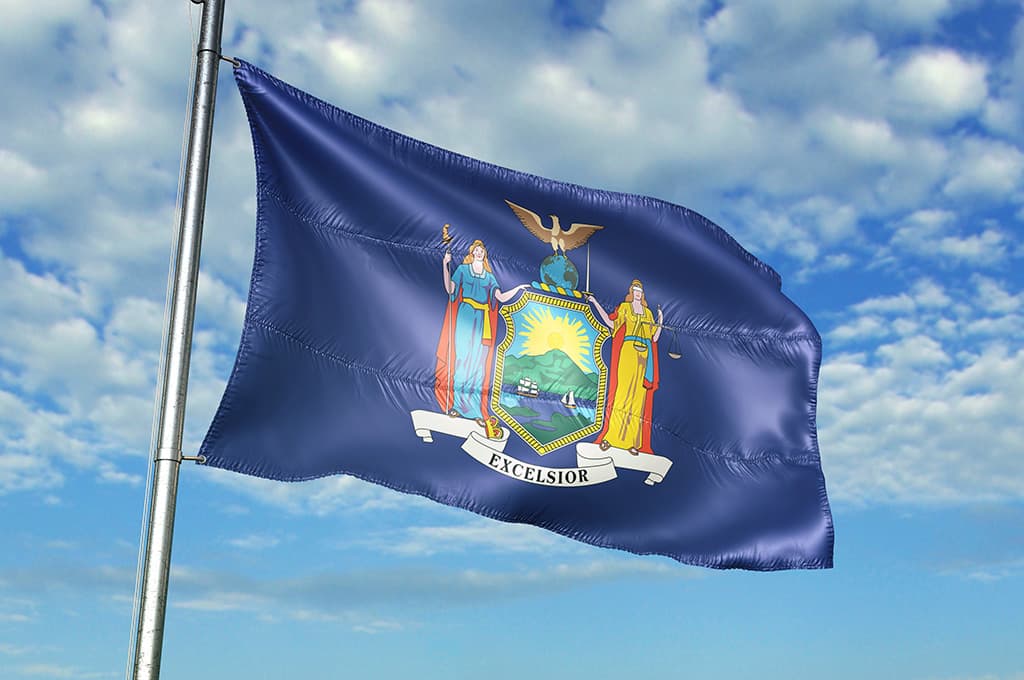
Veteran Benefits in New York

Veteran benefits in New York include property tax exemptions, a full state income tax exemption on military retirement pay, tuition awards that cover SUNY-level tuition, free state park access, and extra points on civil service exams. These state programs supplement federal VA benefits, allowing eligible veterans to use both simultaneously.
This guide covers what each program offers, who qualifies, and which property tax and tuition rules are changing in 2026 and 2027.
Benefit amounts and eligibility rules are accurate as of October 4, 2026. Confirm current figures with the administering agency before you apply.
Veteran Benefits in New York at a Glance
Many veteran benefits in New York depend on wartime service or VA disability rating, and several property tax benefits also depend on whether your town, county, or school district has opted in. The table shows the top tier of each program, which is the ceiling a veteran can work toward.
Benefit area | Potential help | Who may qualify | Next step |
|---|---|---|---|
Military retirement | Full pay exemption | Military retirees | |
Property taxes | Full residence exemption | P&T disabled veterans | |
Vehicles | Registration fees waived | Veterans with VA auto grant | |
Housing | Skilled nursing care | Eligible veterans | |
Education | SUNY-level tuition award | 4-year or combat veterans | |
Healthcare | VA health care | Eligible veterans | |
Employment | Ten exam points | Disabled wartime veterans | |
Recreation | Free vehicle entry | Resident veterans | |
Annuity | Annual cash payment | Legally blind wartime veterans |
Most property tax benefits are local options, so the amount depends on where you live. Program rules, deadlines, and funding availability can change. Eligibility is not automatic.
Tax Breaks and Financial Assistance
New York's largest financial benefits for veterans come from income and property taxes. The income tax break is the same statewide, while the property tax benefits vary a great deal depending on which exemptions your community offers.
Income Tax Benefits
New York does not tax military retirement pay, which matters most for retirees deciding where to settle after separation. Active-duty pay is treated differently, so service members who keep New York as their home state should know which parts of their pay are taxed.
Military retirement pay: Military retirement pay is exempt from New York State, New York City, and Yonkers income taxes.
Combat zone pay: Military pay earned in a designated combat zone is exempt from New York State, New York City, and Yonkers income taxes.
Active-duty pay: For New York residents, other active-duty pay is taxed to the same extent it is taxed federally. Service members stationed in New York who are domiciled in another state do not owe New York tax on their military pay.
How to claim: Both exemptions are claimed as subtractions on the state return, with no separate application.
Property Tax Exemptions
Among veteran benefits in New York are several property tax exemptions. Each county, city, town, village, and school district chooses which exemptions to offer and sets its amounts. Because of this, benefits can vary a lot between neighboring towns. To find out what applies to a specific home, it’s best to contact the local assessor.
Alternative veterans exemption: Wartime veterans receive a 15% reduction in assessed value. Veterans who served in a combat zone or received an expeditionary medal receive an additional 10%. Veterans with a service-connected disability receive a further reduction equal to half their VA disability rating.
Cold War veterans exemption: Veterans who served on active duty between September 2, 1945, and December 26, 1991, receive a 10% reduction, or 15% where the locality opts in, plus half their disability rating. The basic portion lasts 10 years unless the locality has removed that limit. The disability portion has no time limit.
Eligible funds exemption: This older exemption applies to homes bought with eligible funds, such as military pensions, bonuses, insurance, or mustering-out pay. No new eligible funds exemptions can be granted where the alternative exemption is offered.
Local dollar limits: Each percentage is subject to maximum dollar limits set by the taxing jurisdiction, so the actual reduction depends on where you live.
School taxes: The alternative and Cold War exemptions apply to school taxes only if the school district has adopted them.
Who can own the home: The property must be the primary residence of the veteran, the veteran's spouse, or an unremarried surviving spouse. Gold Star parents may also qualify for the alternative exemption, where permitted by the locality.
When to file: File Form RP-458-a (alternative) or RP-458-b (Cold War) with your local assessor. In most communities, the deadline is March 1.
Vehicle Benefits
New York offers fewer vehicle benefits for veterans compared to many other states. The main registration fee waiver only applies to certain groups. However, all honorably discharged veterans can get a free veteran designation on their license.
Registration fee exemption: The Department of Motor Vehicles waives registration and plate fees for veterans who received a vehicle through the VA automobile grant program, and for those who qualify for Medal of Honor or Former Prisoner of War plates.
Free Thruway travel: Disabled veterans with a fee-exempt registration can enroll in the Thruway Authority's Disabled Veteran Non-Revenue E-ZPass Program for free travel on the Thruway.
Veteran designation: Honorably discharged veterans can add "Veteran" to their driver's license, permit, or non-driver ID at no additional fee. Regular transaction fees still apply.
Disability Compensation
Federal VA benefits follow the same rules in every state and are paid on top of state programs. The VA disability rating that sets federal compensation also determines eligibility for several state veteran benefits in New York, so that a rating change can affect both at once.
100% rating: A 100% veteran with no dependents receives $3,938.58 per month in 2026.
Cost-of-living adjustment: This rate reflects a 2.8% cost-of-living adjustment effective December 1, 2025.
Housing, Education, and Healthcare Benefits
Veterans in New York have access to both state and federal programs for long-term care, housing, education, and health care. Each agency has its own rules and costs, so it’s a good idea to compare your options before you apply.
State Veterans Homes and Cemetery
The state has its own skilled nursing homes and a veterans cemetery, which are separate from VA medical centers and national cemeteries. If you are planning long-term care or burial, it is often a good idea to compare what the state and federal programs offer.
Veterans homes: New York has five state veterans homes in Batavia, Montrose, Oxford, St. Albans, and Stony Brook on Long Island. They are run by the Department of Health and the State University of New York.
Who qualifies: Applicants must have entered active duty from New York or have been a New York resident for one year before applying.
Cost: The Department of Veterans' Services (DVS) states that veterans pay no out-of-pocket costs for routine skilled nursing care in a state veterans home.
State cemetery: The New York State Veterans Cemetery, Finger Lakes, in Romulus, is the state's first state-run veterans cemetery. Burial is open to veterans discharged under other than dishonorable conditions, their spouses, and eligible dependent children.
Adapted Housing Grants
VA grants help veterans with service-connected disabilities buy, build, or change a home to fit their needs. The main programs are Specially Adapted Housing (SAH) and Special Housing Adaptation (SHA). Veterans can use these grants up to six times in their lifetime.
VA updates these grant limits by fiscal year. Check VA.gov for the current SAH and SHA maximums before applying.
Education Benefits
New York's main state education benefit for veterans is the Veterans Tuition Award (VTA), run by the Higher Education Services Corporation (HESC). Since July 1, 2025, veterans with four years of active duty qualify even without combat service, which opened the award to far more veterans than before.
Award amount: The VTA covers tuition up to the average SUNY undergraduate tuition rate, or actual tuition if that is lower. For 2025-26, the cap was $7,070 a year.
Where it applies: The award can be used at SUNY, CUNY, private colleges, and approved vocational training programs in New York.
Who qualifies: Veterans with at least four years of active duty, or who served in combat in Vietnam, the Persian Gulf, or Afghanistan, or who received an expeditionary medal. Applicants must not have been dishonorably discharged and must have lived in New York for 12 continuous months.
How long it lasts: Up to eight full-time semesters of undergraduate study, six semesters of graduate study, or four semesters in a vocational program. Part-time awards are prorated by credit hour.
How to apply: Complete the FAFSA and the Tuition Assistance Program (TAP) application first, then the VTA application. The application is open year-round.
VA Health Care in New York
These VA medical centers and health care systems serve New York:
VA NY Harbor Healthcare System: Manhattan and Brooklyn.
James J. Peters VA Medical Center: Bronx.
Northport VA Medical Center: Northport.
VA Hudson Valley Health Care System: Montrose and Castle Point.
Albany VA Medical Center: Albany.
Syracuse VA Medical Center: Syracuse.
Bath VA Medical Center: Bath.
Canandaigua VA Medical Center: Canandaigua.
VA Western New York Healthcare System: Buffalo and Batavia.
Pension With Aid and Attendance
The VA pension with Aid and Attendance supports wartime veterans and surviving spouses who need help with daily tasks. The amounts listed below show the highest possible yearly pension, broken down by month. The VA lowers the payment based on your countable income, so these amounts are the maximum you could receive, not the exact payment.
Recipient | Maximum Monthly Equivalent |
|---|---|
Single veteran | About $2,424 |
Veteran, one dependent | About $2,874 |
Two veterans married to each other, both qualifying | About $3,845 |
Surviving spouse, no dependents | About $1,558 |
Surviving spouse, one dependent child | About $1,858 |
VA publishes pension rates as annual amounts. The figures above divide each 2026 annual maximum by 12 and round to whole dollars to allow comparison with monthly benefits such as disability compensation.
New Benefits for 2026 and 2027: What Actually Changes
New York has introduced two important new benefits for veterans, starting in late 2026 and mid-2027. Both have some conditions that are easy to overlook. One benefit depends on whether your local community chooses to participate, while the other is limited by how many veterans statewide can use it each year.
Full Property Tax Exemption for Permanently and Totally Disabled Veterans
What it covers: A full exemption from property taxes, special ad valorem levies, and special assessments on the primary residence of a veteran with a permanent and total disability from military service.
Local option: Municipalities and school districts choose whether to offer it, so eligibility depends on where you live.
Start date: If offered, the exemption applies to assessment rolls based on taxable status dates as of October 1, 2026.
Who qualifies: The veteran needs a VA letter or form that specifically states they are permanently and totally disabled as a result of service. They must also meet the alternative veterans exemption requirements and have an honorable discharge, unless they qualify under the Restoration of Honor Act.
How to apply: File Form RP-458-a, which now covers both the alternative exemption and the permanent and total disability exemption, with your local assessor.
Veterans Tuition Award Transfers
Start date: July 1, 2027.
What transfers: A qualified veteran who has not used their Veterans Tuition Award can transfer all or any remaining award one time to one eligible family member.
Who can receive it: A spouse, a child under 26, or a financial dependent of the veteran who lives in New York.
Annual cap: No more than 100 transfers are allowed statewide each year. HESC can set an application deadline and a selection method if more veterans apply.
Cold War Exemption in New York City
What changed: New York City adopted the Cold War veterans exemption in December 2025. Before that, it was the only major jurisdiction in the state not to offer it.
Who it helps: Veterans who served between September 2, 1945, and December 26, 1991, and who own a primary residence in the city, along with their spouses or unremarried surviving spouses.
If you have a permanent and total rating, ask your assessor now whether your town, county, and school district have adopted the new exemption. If you have unused tuition benefits and a family member heading to college, plan for the 2027 transfer window early, since the cap is small.
Employment and State Assistance
New York's remaining state benefits cover public-sector hiring, recreation, and annual payments for certain veterans and families. Several different agencies run these programs, so veterans apply to each one separately.
Civil Service Veterans Credits
For veterans moving into public-sector work, New York adds credits to passing scores on competitive civil service exams for state and local government jobs. The credits are generally a one-time benefit, so it pays to use them on the appointment that matters most.
Veterans: Qualifying wartime veterans receive five points on open-competitive exams and 2.5 points on promotional exams.
Disabled veterans: Veterans with a service-connected disability rated at 10% or more receive ten points on open-competitive exams and five points on promotional exams.
One-time use: Credits can be used for one permanent appointment. Veterans who used non-disabled credits and are later rated as disabled can use the difference on a later exam.
Residency: Applicants must be New York residents when they apply for the credits.
State Parks, Hunting, and Fishing
New York gives resident veterans free access to most state parks and discounted hunting and fishing licenses for disabled veterans. State Parks and the Department of Environmental Conservation (DEC) run these programs separately.
Lifetime Liberty Pass: Since April 1, 2024, New York resident veterans and Gold Star parents, spouses, and children have received free vehicle entry to state parks and DEC day-use areas, boat launches, and historic sites, plus discounted camping. The pass is free and never expires.
Using your ID instead: Veterans with the veteran designation on their DMV license or ID can present it at staffed facilities in place of a pass.
Veterans rated 40% or higher: Resident veterans with a service-connected disability of 40% or more can get a Sportsman license (fishing, big game, and small game) for $5, plus free bowhunting and muzzleloading licenses.
VA patients: Veterans receiving care at a VA hospital or facility can get a free fishing license through that facility.
Annuities for Blind Veterans and Gold Star Parents
New York pays two annual annuities through DVS. Both are paid in cash each year rather than as a discount or exemption.
Blind Annuity: Legally blind wartime veterans who live in New York and are domiciled there can receive an annual payment. Blindness need not be service-connected, and unremarried surviving spouses may also qualify.
Annuity amount: State law sets the veteran's annuity at $1,000 a year plus annual adjustments tied to VA cost-of-living increases. DVS publishes the adjusted amount each year by February 1.
Gold Star Parent Annuity: DVS also pays an annual annuity to Gold Star parents who live in and are domiciled in New York.
How to Start Checking Your Eligibility
The most valuable veteran benefits in New York depend on your service dates, your VA disability rating, and whether you own a home. Confirming all three up front tells you which programs to apply for and which local options to ask about.
Then review the benefits in this order:
Gather your DD-214 and your VA rating letter, including any letter showing a permanent and total rating.
Ask your local assessor which veterans' exemptions your town, county, and school district offer.
File Form RP-458-a or RP-458-b before your community's deadline, which is March 1 in most places.
Claim the military retirement subtraction on your state return.
Apply for the Veterans Tuition Award through HESC after completing the FAFSA and TAP application.
Add the veteran designation to your license or order a free Lifetime Liberty Pass.
Making New York's Benefits Add Up
Veteran benefits in New York depend on two things more than in most states: your service record and your address. Service dates, combat medals, and your VA rating decide which programs you qualify for, while your town, county, and school district decide how much several property tax benefits are actually worth.
That makes your local assessor one of the most useful calls you can make. Ask which exemptions are offered where you live, whether the new permanent and total disability exemption has been adopted, and when the filing deadline falls.
From there, claim the benefits that recur each year first, then plan for those that open up in 2027.
FAQ
Can I receive more than one New York veterans property tax exemption?
Generally not for the same tax. The Cold War exemption cannot be granted for the same taxing purpose as the alternative or eligible funds exemption. One exception: if your school district offers the alternative exemption but not the eligible funds exemption, a veteran who already has the eligible funds exemption can apply for the alternative exemption for school taxes only.
Do I have to reapply for the property tax exemption every year?
No. Once you are approved, the exemption continues in future years. You will need to refile if you move or if your VA disability rating changes.
Does New York tax VA disability compensation?
No. VA disability compensation, pensions, and grants are exempt from New York State income tax.
Can I use the Veterans Tuition Award with the GI Bill?
It depends on which GI Bill. Veterans using the Montgomery GI Bill can still receive the award. Veterans using the Post-9/11 GI Bill or the Yellow Ribbon program are not eligible if either program already covers their tuition. Your total aid also cannot exceed your cost of attendance.
Who can help me apply for these benefits?
DVS Veterans Benefits Advisors, who are veterans themselves, offer free benefits advising by phone, video, or in person. Call 1-888-838-7697 or contact your County Veterans' Service Agency.